Crealab
How to prepare your business for AI-agents

Today, more and more people have an AI assistant within reach, often just a flick of the finger away. It might be ChatGPT, Claude, Gemini, or a voice assistant on their phone.
Instead of browsing websites themselves, people increasingly ask their assistant questions like: “Find me a good travel bag under €200.”
The AI then decides which brands exist, which products are relevant, and where to buy them.
And that raises an important question for businesses: How do you make sure AI assistants know about your products and services?
Mars 2026
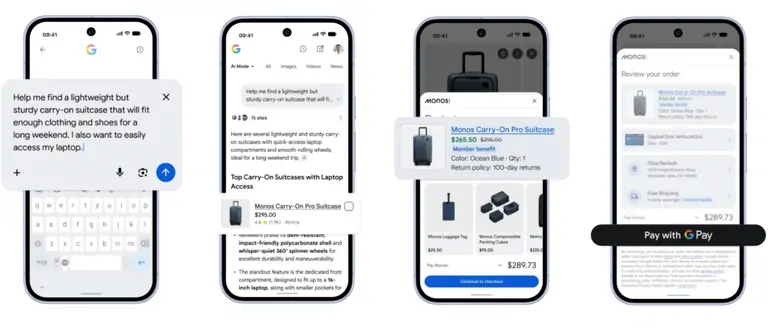
Screen images simulated. Google UPC Guide
➮ AI-Agents: the new target audience
For a long time, humans discovered businesses by searching the web themselves. They searched on Google, clicked a few links, compared products, and eventually decided where to buy.
But AI assistants changed that flow. Today a potential customer might simply ask their AI assistant to do the research, the assistant then spins up AI Agents that summarizes reviews, compares prices, navigates websites, recommends a product and sometimes even finishes the purchase.
In this scenario, the AI Agents become the middle layer between businesses and customers. And that changes how visibility works online. An AI agent, essentially a robot or “virtual worker”, that interacts with your digital presence, websites and apps, becomes a new target audience to accommodate and impress.
Until recently it has been enough for companies to focus on search engine optimization, good website design, and online ads to reach customers directly. But when an AI agent sits between you and the user, the rules start to evolve.
Companies will have to make their products or services visible to AI-agents as well - sooner or later.
When a user asks an AI assistant “Find the best project management software for agencies”, the AI may combine information from product websites, review platforms, blog articles, and community discussions before recommending tools.
➮ How AI agents learn about your business
To know about your business, AI agents need to find and understand information about your business. Usually they do this by finding your websites, social media accounts or other sources, and then scraping, indexing and summarizing that information. Your information needs to be structured, machine-readable and quickly accessible.
While you can’t decide in detail how an AI agent reads your website, you can make it easier for the agent to understand the information through your choice of technologies.
Today in March of 2026 these technologies fall into three main categories:
🤖 Clean HTML & Structured web data
Established web standards like Schema.org and JSON-LD that help machines understand your business.
Still relevant, but often a missed opportunity for many businesses.
🤖 API-based integrations
Earlier structured APIs that allow AI systems to connect to and interact with your business.
🤖 Emerging agent protocols
New standards designed specifically for AI agents to interact with your business and other systems or services. And much more. Right now that ecosystem is evolving quickly.
Each of these approaches might play a role in making your business visible and usable for AI assistants.
🤖 Clean HTML & Structured web data
While AI models (LLMs) have become incredibly good at reading natural language, they still rely on structured data to verify facts and disambiguate entities. Your content needs to be clean and structured to be machine-readable and machine-understandable.
The new era of structured data and schema.org
AI agents (like ChatGPT, Claude, or Perplexity) don't just "read" your site; they try to "reason" about it. When an agent finds structured JSON-LD, it acts as a Source of Truth.
Precision: If your text says "The price is 200," an AI might guess if that's the price, the weight, or the version. JSON-LD explicitly defines price: 200.
Trust: Agents prioritize "grounded" data. Sites with valid Schema are cited more frequently because the AI is more confident it won't hallucinate the details.
More information about this technology:
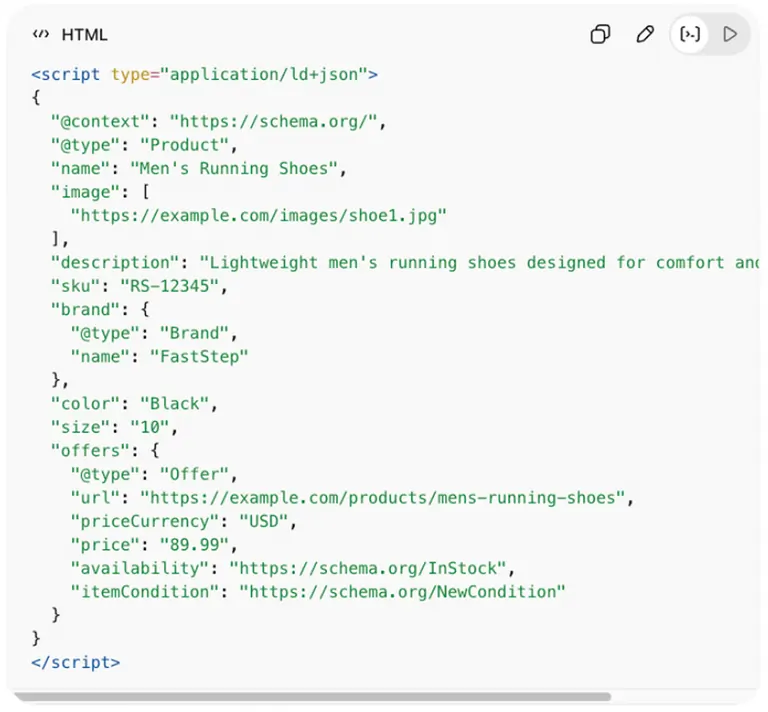
As an example. In the case of a product sold on an ecommerce website. Schema.org+JSON-LD can tell the machine that:
For example using the https://schema.org/Product type.
- The webpage is about a product.
- The name of the product.
- That the product is a shoe.
- The price of the shoe.
- The color of the shoe.
- The size of the shoe.
- The brand of the shoe.
- If the shoe is in stock.
And much more…
The concept of structured data, in the form of Schema.org and JSON-LD, came to be as a part of the semantic web project, 15 years ago, all the way back in 2011. However, the adoption was slow, and has been slow over the years. Not because the concept was bad, it’s actually still great. Slow adoption was because a lot of human time and effort was required from each business, to structure their own data.
Still today many businesses have missed this opportunity for greater visibility.
Clean HTML, increasingly relevant
At the same time, clean and well-structured code still plays an important role. Clean code is often connected to high web performance, and with that visiting AI-agents will understand your content faster and finish their tasks faster with less errors.
Clear HTML structure makes it easier for AI-agents to interpret your HTML and make better sense of what it’s about.
For visiting AI-agents this means that they have to do less guess work.
AI agents also learn about your brand from the web
AI agents don’t rely only on your website. They also gather information about companies from trusted sources across the internet.
These sources help AI systems understand a brand’s reputation, expertise, and relevance.
Examples include:
- Wikipedia – structured information about organizations
- Media mentions – articles in news sites and tech publications
- Review platforms – customer feedback and ratings
- Industry blogs – expert commentary and niche publications
- Community platforms – discussions on Reddit, YouTube, and LinkedIn
Together, these signals help AI agents build a broader understanding of your business and increase the chances that your brand appears in AI-generated recommendations.
🤖 API-based integrations
While new agent protocols are still evolving, AI assistants are already able to interact with many services through existing APIs.
The table below shows some of the main API-based approaches used today.
These tools allow AI systems to interact with existing digital services through APIs. For many businesses, this is the most practical way to enable AI integrations today, since many companies already expose APIs for their platforms.
However here the integration might be vendor-specific and there are not many widely adopted standards, which makes implementations costly and hard to reuse for many businesses. That is the gap the many emerging protocols are trying to overcome.
🤖 New emerging agentic protocols and standards
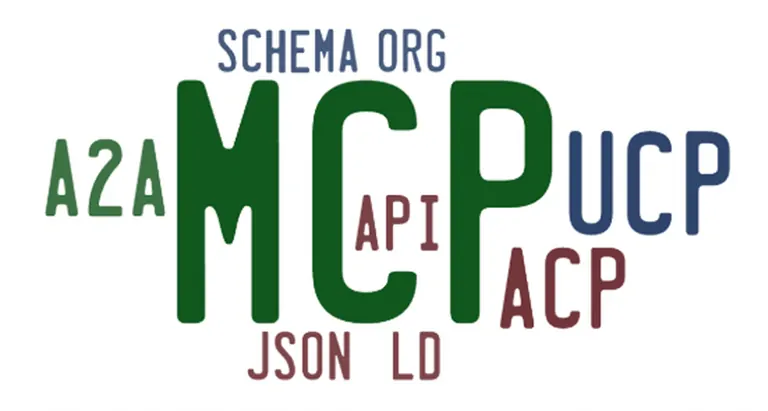
The landscape of agentic protocols is currently a “battle of the standards”, much like the early days of the web.
It might look a bit chaotic, because it is. There are many abbreviations to keep track of, and some standards even use similar names.
The reason is simple: controlling the standard that everyone else builds on is an incredibly valuable position. Many of the major tech companies are trying to define these protocols, hoping their approach becomes the one others adopt.
This becomes especially clear in e-commerce. The protocol that AI agents use to discover, compare, and buy products could become the infrastructure of future digital markets.
Below is a quick overview of some of the emerging agent technologies.
So what problems are these protocols trying to solve?
One of the biggest challenges is that AI agents work best with predictable and standardized patterns. Without them, the agent has to relearn how every website or system works.
Traditional REST APIs often leave a lot of freedom to developers, which means implementations can vary widely.
For example, one online store might expose a shopping cart endpoint like: addtocart/product/123
while another might use: cart/add/123
For humans this difference is trivial. But for AI agents trying to interact with thousands of services automatically, it quickly becomes messy.
➮ So where should you go next?
With so many new technologies emerging — and a few mature ones already in place — it can be difficult to know where to start.
A good first step is to focus on the basics.
First of all make sure your html is clean, well structured and your website performance is great. This is foundational and helps both visiting AI-Agents and Humans. It also helps you with the next step.
If you haven’t already implemented Schema.org using JSON-LD, that’s a great place to continue. Structured data helps both traditional search engines and automated systems understand what your website offers, whether that’s products, services, events, or other content.
From there, it’s worth taking a step back and looking at your own situation.
- Do you actually need something like an MCP server or support for emerging standards such as Googles UCP?
- Will your customers realistically interact with your business through AI assistants?
These questions don’t have clear answers yet. While the use of AI assistants is growing quickly, it is still evolving how people will use them to discover, compare, and purchase products.
What is clear, however, is that the companies behind the largest AI platforms are investing heavily in this direction. Many of them are betting that AI agents will become an important interface between users and digital services.
Exactly how this ecosystem will develop is still uncertain, but making your business understandable to machines is already becoming increasingly important.
If you need help preparing your business for AI, from structured data and APIs to content and MCP integrations, we can help.
If you want to understand how AI systems interpret and recommend your business, start with an AI Trust Diagnostic.
+46 733 50 33 90
hello@lescreatives.com
Östgötagatan 12
116 25 Stockholm
Sweden
© 2025 Les Creatives Stockholm AB
CRN: 556905-9792